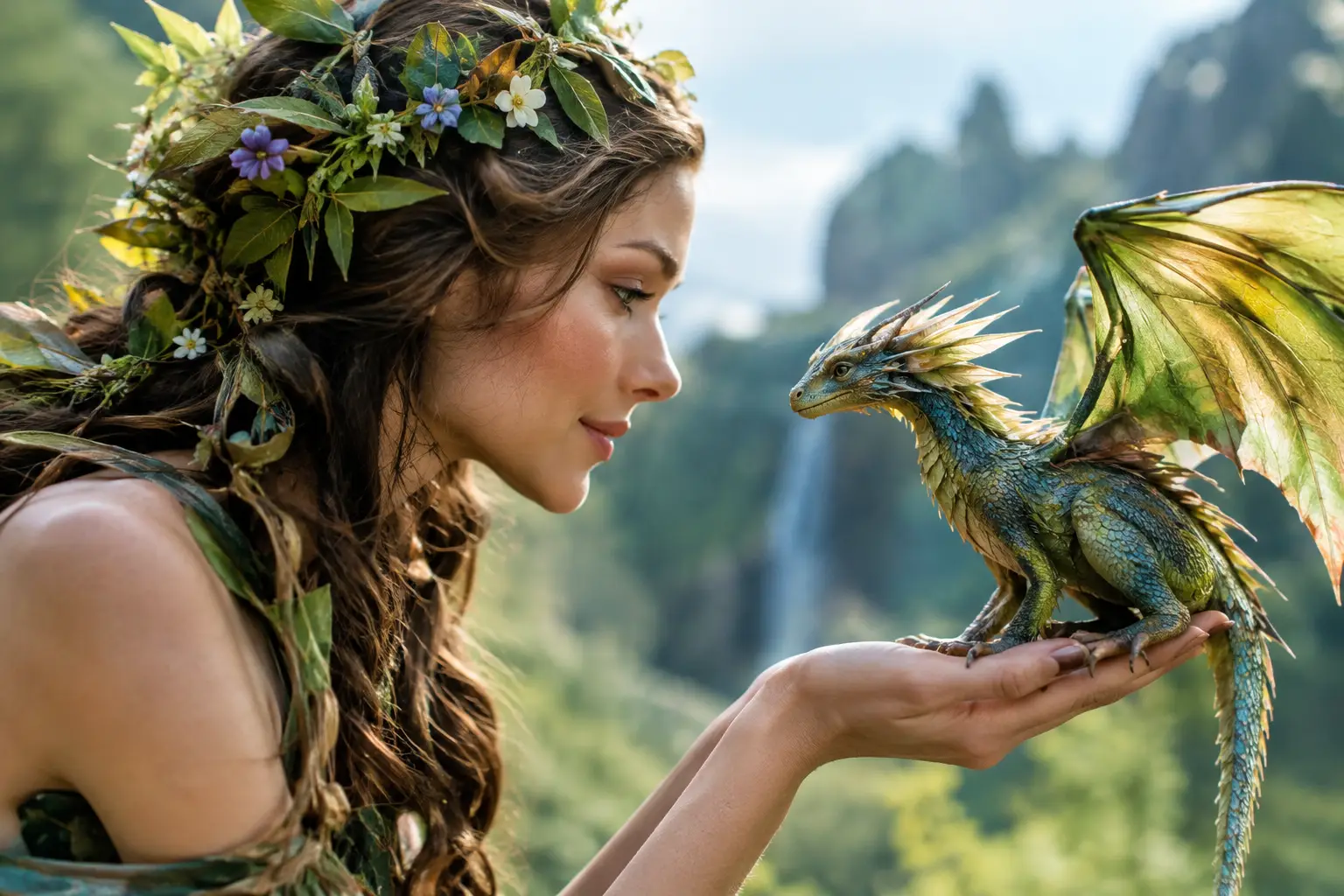
A dragon perched on a blank gray rock can be striking. A dragon whose scales mirror wet river stones, whose wing membranes catch the green light of a forest canopy, and whose claws press into roots has a world around it. That is the lasting pull of nature inspired fantasy art: it does not merely place a mythical creature near a tree. It lets the living logic of nature shape the fantasy.
For artists, collectors, and commissioners, that distinction matters. It is often what separates an attractive image from a piece people return to, save, print, discuss, and remember. Nature gives fantasy art texture, history, and a sense that the scene continues beyond the frame.
Why Nature Inspired Fantasy Art Feels So Convincing
Fantasy asks viewers to accept the impossible. Nature gives them something familiar to hold onto. We may not have seen a stag with antlers made of flowering branches, but we understand the weight of antlers, the seasonal cycle of blooms, and the way a woodland animal moves through cover. Those recognizable details make the invention feel earned.
The strongest work usually begins with observation rather than decoration. A mountain dragon should not only have gray scales because mountains are gray. Its silhouette might echo a ridgeline. Its wings may be broad enough to ride an updraft. Lichen may gather in the folds of old armor-like skin. The creature becomes part of an ecosystem, not a mascot pasted into a landscape.
This is also why a single natural reference can be more powerful than a pile of generic fantasy symbols. The translucent veins of a moth wing, the bark pattern of a sycamore, or the amber eyes of a wolf can suggest an entire visual direction. Specificity carries its own magic.
Build a World From an Ecosystem, Not a Color Palette
A palette is a useful starting point, but it cannot do the full job. Green and gold do not automatically create an enchanted forest, just as blue does not automatically create a believable ocean realm. A world begins to feel alive when its climate, materials, light, and inhabitants belong together.
Consider what grows there, what survives there, and what leaves a mark. In a rainy temperate forest, feathers may be damp, stone may shine darkly, and fungi might climb fallen trunks. In a dry canyon kingdom, a gryphon’s plumage could carry dusty ochers while its nest is tucked beneath sun-warmed overhangs. These choices give the work internal continuity.
For digital artists, reference gathering is not a shortcut around imagination. It is fuel for it. Study real leaves at different stages of decay. Notice the asymmetry in horns, rocks, wings, and branches. Watch how reflected light changes a creature’s underside. The goal is not photorealism in every piece. Stylized art can be deeply convincing when it respects a few true natural behaviors.
A useful question during the sketch stage is: what happened here before the viewer arrived? A broken branch, a trail through moss, a startled flock, or pollen caught on a creature’s fur can answer that question without a paragraph of lore.
Let creatures belong to their habitats
Creature design becomes more memorable when function and environment meet. A dragon that lives among storm clouds might have scale edges that diffuse electrical charge. A marsh guardian could have broad feet, reed-like frills, and muted coloring that vanishes into shallow water. A nocturnal forest familiar may have oversized ears, but also eyes adapted to low light and a posture built for listening.
There is a trade-off here. Pushing realism too far can make a fantasy creature feel like a wildlife diagram. Ignoring function entirely can make it feel detached from its own setting. The sweet spot depends on the piece. A dramatic character portrait can prioritize expression and silhouette; a full environmental scene has more room to reveal how the creature lives.
The Details That Create Emotional Atmosphere
Nature does not only make fantasy plausible. It sets the emotional temperature. A calm lake at dawn, thorny brambles at twilight, and a wind-bent alpine meadow can each frame the same dragon as a different kind of being: guardian, threat, wanderer, or ancient witness.
Light is especially powerful. Dappled sunlight suggests shelter and discovery. Overcast light lets color shifts in fur, stone, and feathers take center stage. Moonlight can create mystery, but it needs restraint. If every surface glows equally, the scene loses depth. Let darkness keep some of its secrets.
Scale matters, too. A tiny sprite standing in a colossal mushroom grove creates wonder through contrast. A massive creature partially hidden by trees can feel more imposing than one shown in full. Viewers instinctively read the size of leaves, ferns, birds, and human-made objects. Use those anchors to make the extraordinary feel truly enormous or wonderfully intimate.
Then there is imperfection. Bent petals, chipped horns, scarred bark, mud on paws, and a wing with an uneven edge all suggest time. Perfect surfaces may suit celestial or ceremonial designs, but a natural world benefits from signs of weather, growth, and use.
How Collectors Can Recognize Work With Staying Power
Collecting fantasy art is personal. You do not need an art-history argument to love a luminous dragon curled around a cedar tree. Still, if you want artwork that continues to reward attention, look for choices that go beyond immediate visual impact.
First, look closely at the relationship between subject and setting. Does the landscape only fill empty space, or does it change how you understand the character? Notice whether repeated shapes connect the composition: antlers echoing branches, cloud forms repeating wing curves, or jewel tones appearing in both flowers and scales.
Second, consider the artist’s point of view. Two artists can paint the same woodland drake and produce entirely different emotional worlds. One may focus on quiet observation, another on kinetic adventure, another on playful folklore. A distinctive visual voice often matters more than a fashionable motif.
Finally, imagine where and how you want to encounter the piece. A detailed panoramic print can reward a slow, close look in a reading space. A bold portrait may command a gallery wall. Digital collectors may value process notes, alternate crops, or an artist’s evolving body of work. The right format depends on the connection you want with the art, not just the dimensions of the file or print.
Curated spaces such as StarDragon Studios can make this discovery more human by placing original artwork, artist portfolios, and themed collections in conversation. That context helps collectors find creators whose worlds genuinely resonate rather than scrolling past endless unrelated images.
Commissioning Nature-Inspired Fantasy Art With Clarity
A commission can produce something no general marketplace search will ever find: a creature, place, or story shaped around your own connection to nature. The best requests leave room for an artist’s strengths while offering enough detail to guide the work.
Start with the emotional core. Instead of asking only for a dragon in a forest, describe the feeling: protective and ancient, playful after rainfall, solitary beneath autumn branches. Then add a few grounded anchors, such as a specific biome, season, animal influence, or natural material. A commissioner who says, “I love coastal tide pools, kingfishers, and stormy teal light,” gives an artist far more to work with than a broad request for an ocean dragon.
Reference images help, but they should clarify rather than dictate. Share them to communicate texture, lighting, anatomy, or mood, and be clear about what you respond to in each image. Avoid asking an artist to replicate another creator’s design or style. The point of commissioning is to receive an original work shaped by a real creative partnership.
Practical details protect that partnership. Confirm the intended use, timeline, revision process, budget, final deliverables, and rights before the work begins. A transparent commission portal, written agreement, clear progress updates, and organized client communication may sound less romantic than a moonlit dragon flight, but they allow the creative side to remain joyful.
Give Nature Room to Surprise You
The most compelling nature-inspired fantasy art rarely comes from trying to make every leaf magical. It comes from noticing that the real world is already strange: mushrooms that glow, birds with impossible color, roots that split stone, and creatures built for places humans can barely enter.
Whether you are making work, collecting it, or bringing a commission to life, begin with one real detail that genuinely fascinates you. Follow it patiently. A whole realm may be waiting inside the curve of a shell, the pattern of a feather, or the watchful eye of something scaled beneath the ferns.